
PROSTHETIC COVERS
Helping grow confidence in everyday amputees.
This project was done alongside New Zealand Artificial Limb service and an independent consultant. The goal was to create a product, initially for the New Zealand market, that is affordable and helps reduce stigma surrounding prostheses, as well as grow amputees confidence.

Design a product for New Zealand Artificial Limb Service.
User Research
Research began by identifying gaps in the market. Once we
identified the need for cheaper prosthetic covers, we started
our user research. Through interviews with prosthetic users and
technicians I found out the following:
• The highest percentage of amputees who were interested
in wearing covers over their prosthetics were females below the
age of 30. The least were elderly, both male and female.
• Needs to have sock consideration, if they were to wear
socks would the shape still look normal?
• Does it fill the trousers?
• The gap between the rubber foot and the fairing can
make noises and put patients off.
• Cannot use magnets on pylon as they are stainless steel or
aluminium.
• Everyone has their own opinion, not one design will be
liked by everyone.
Solutions.
The following are potential solutions to the user research:
• Target the younger age groups first.
• Keep the natural leg from, but change the details.
• Use 3D scanning to match the other leg.
• Keep a 1 inch gap between foot and cover.
• Clips
• Provide a service to allow for customization.
Form Development.
Exploring the different forms allowed us to identify whether users
wanted it to look natural or artistic. We then looked at different
methods to attach it to the pylon.
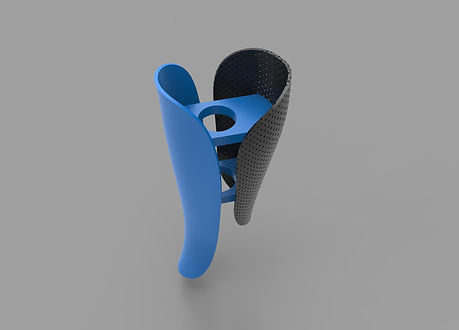

Functionality.
After many iterations we came to the conclusion that the
most effective way to attach the cover to the pylon was using
a foam insert that is a common material used by prosthetic
technicians. It is non slip and extremely durable.


Aesthetics.
Throughout the form development we experimented with
aesthetics and customisation. We found that allowing the user
to choose their own design/image and it be printed on the
cover, meant it appealed to a wider range of users. The form
design of the cover itself would remain the same.


Brief
Project Summary
/Interviews
/Indusrty Research
/Problem Analysis
/Ideation
/Material Research & Testing
/Scale Models Testing
/Full Scale Testing
/Manufacturing Process
/Ethics
Software Used
/Adobe Illustrator
/Adobe Photoshop
/Rhino 3D
/Meshmixer
/Keyshot
/Artec Eva/Spider 3D scanning
Personal Development
/Empathy
/Software
/Cyclical process
/Manufacturing Process
/Communication
/Presentation
/Business and Design Relationship
/Consulting
/Ethics